


DataRobot
Leading design across a complex AI platform
Role: Head of Design
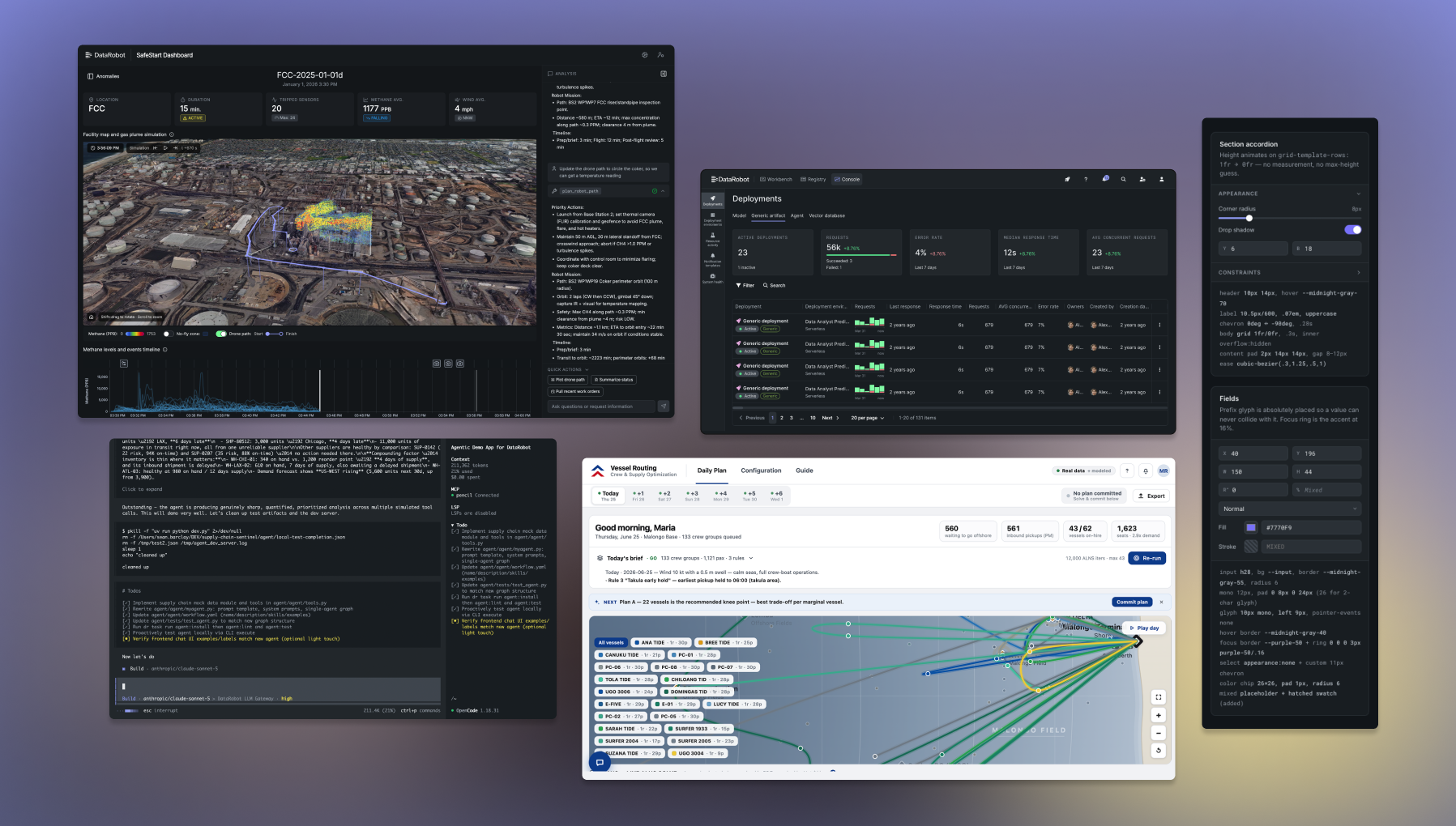
DataRobot is an Enterprise AI platform that helps technical teams build, deploy and manage predictive models, generative AI and agents. The product spans development, evaluation, deployment and ongoing monitoring, with both visual and code-based workflows. Making those parts understandable together was central to our work.
As Head of Design at DataRobot, I led an eight-person team working across predictive AI, agents, governance and developer tools. I set design direction and standards, supported design owners, and partnered with the CPO, CTO and VPs of Product and Engineering on product strategy.
Our challenge was to make development, evaluation, deployment and monitoring work as a coherent experience for technical teams at Chevron, Dell, Geico, NVIDIA, and others.
Setting direction across the platform
I’d only been at DataRobot a few months when we had our leadership summit in Boston back in April 2026. Going into it, I’d been digging through a lot of UX research and talking with colleagues, and one thing kept standing out: we really needed to prioritize reliability for our agents. Once I brought that up, the group pretty quickly agreed. We realized we weren't giving people a smooth, stable, reliable way to build and run agentic apps on DataRobot yet.
Getting on the same page about that basically set my team’s direction from there. It’s what pushed us to focus on Agent Assist, Manage at Scale, Workloads for inference deployment, and Token Grid for inference management, along with making some much-needed improvements to the trial experience.
Our DevEx work covered agent authoring and making Agent Assist more reliable.
We also worked on using AI tools to speed up design and development. The Workloads and Agent Assist examples below show how we carried this work forward.
After Workloads reached GA, I asked the team to revisit usability findings that had been deferred during the release. That work led to fewer build steps and visible build logs.
How I led the work
First, I built up a design capability beyond the team
With shared prototyping tools, hands-on training, and open research, colleagues didn't have to wait on UX to explore new ideas.
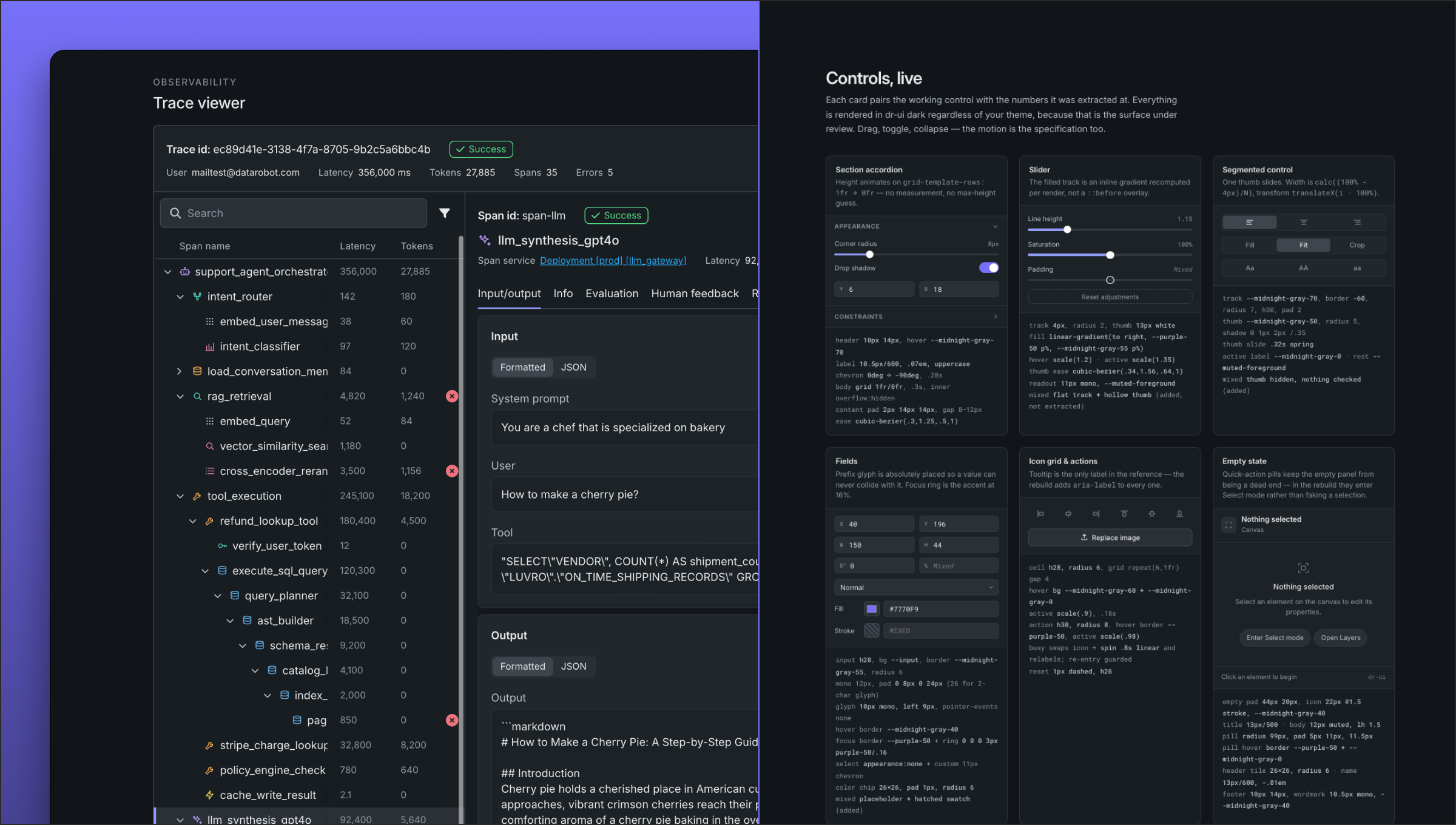
LEFT: Functional prototype for Tracing built using Claude Code + DR-UI styles. RIGHT: A DataRobot-branded starting point for AI-assisted prototyping, built using the team’s DR-UI design system.
Enable others to build:A shared foundation for AI-assisted design
In my first weeks I brought the team together for a summit. We agreed on our principles: deliver user value, make intentional decisions, and hold a high bar for aesthetics, behavior, interaction, and research rigor. We named what helps us succeed, what burns people out, and how to defend standards under deadline pressure. Then we set our 2026 priorities: workload and deployment management, code-to-workload capabilities, and better observability.
Next, I brought AI tools into our practice (Claude Code, Figma Make, Cursor, Claude Design) so we could explore more ideas and put prototypes in front of people sooner. I packaged DR-UI, our shadcn/ui-based design system, as a design.md, AI skills, reference files, and guides, so designers, researchers, PMs, engineers, and the Solutions team could build consistent, on-brand apps. Designers estimated it cut design time up to 80% from concept to handoff. In 2026, we added 18 components to DR-UI.
80%
Designers’ estimate of time saved from concept to handoff with AI skills and design tools
UX Education:
Teach the methods as well as the tools
With my Principal Product Designer and Product Researcher Lead, I ran UX training for the Solutions team on design, research, and tools. Colleagues building customer solutions could then use the methods themselves, instead of waiting for us to review each app.
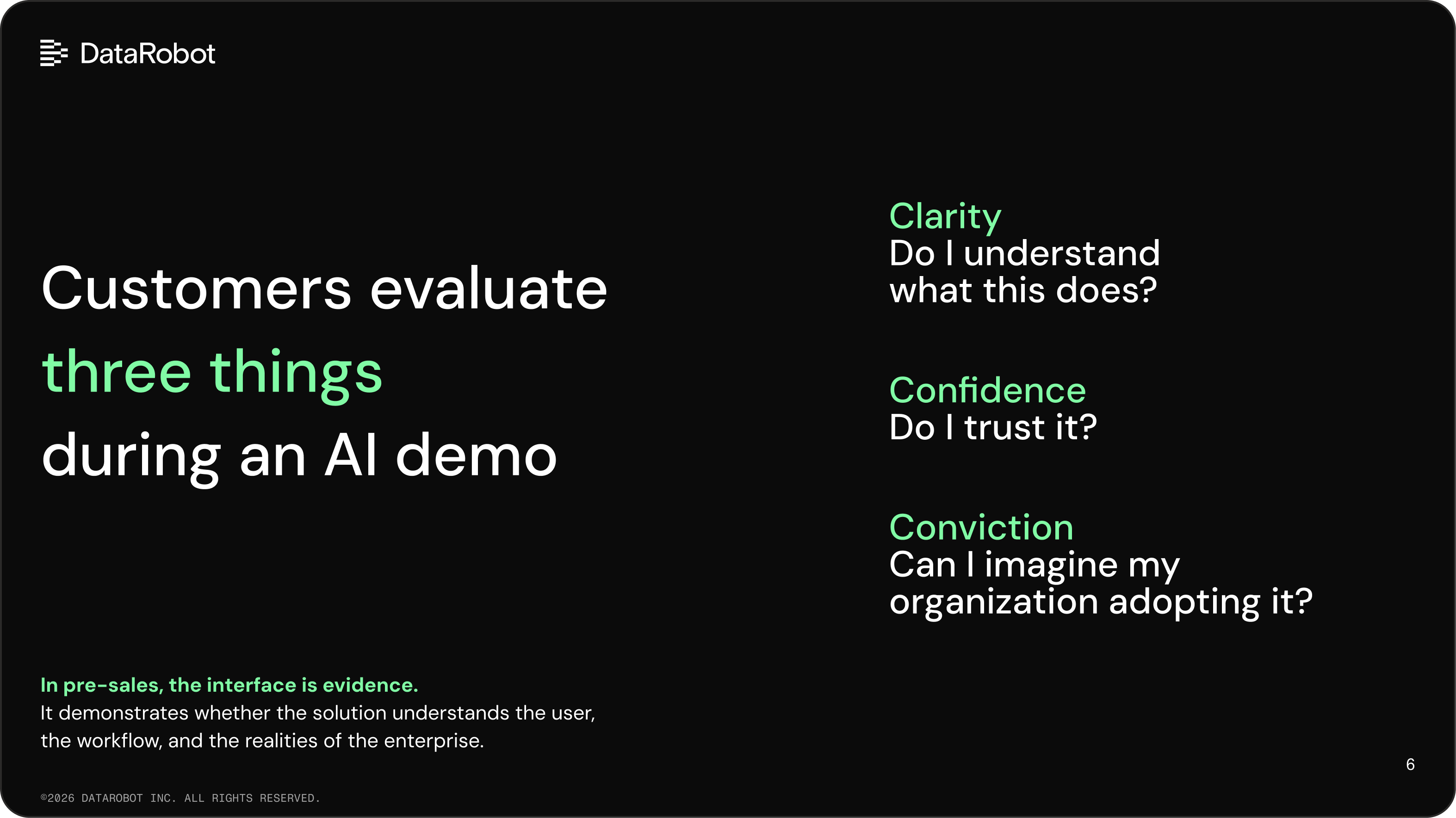
Research enablement: Scaling research beyond the research team
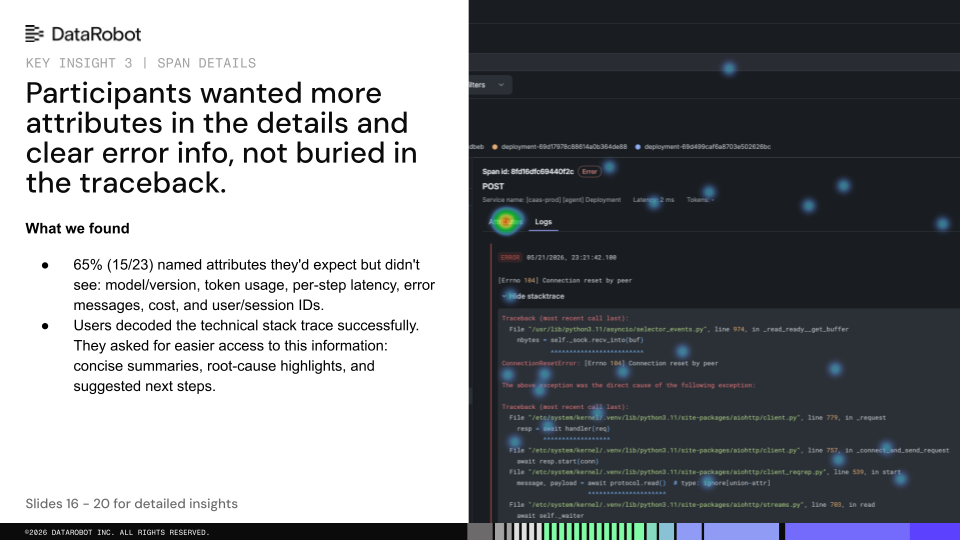
My UX Research Lead and I rolled out User Interviews, Dovetail, and Ballpark alongside hands-on training, giving PMs and engineers what they needed to run moderated and unmoderated studies without a researcher in every room.
The point wasn't just giving teams access to new software; it was making research a regular part of their workflow. Good studies still come down to asking the right question and turning user behavior into a product decision, so we made sure people knew how to do both.
Second, the work we did together
Across all projects, I set direction, reviewed prototypes, supported design owners and worked through decisions with Product and Engineering.
Agent Assist
Released February 2026
Agent Assist helps developers plan, code, and deploy AI agents through natural language conversation. Two pieces shipped while I led design and research: the CLI experience, and the Local Experimentation UI. Agent Assist launched in preview in February, and Local Experimentation followed in June.
My team researched the two. Our designers worked on Local Experimentation and agent tracing. I set direction, reviewed the work, and partnered with Product and Engineering.
Research by my UX Research Lead, found confusion and long waits. One Agent Assist run took more than 15 minutes without explaining what was happening.
We took those findings to Product and Engineering. Engineering added stage-by-stage explanations of how the Starter App was being built, plus a prompt asking whether users wanted to run a simulation before deploying.
Separately, after the Workloads API release, we saw some runs go from starting Agent Assist to a usable Agentic Starter App deployed on DataRobot in less than five minutes, which was a significant improvement.
“
...it was pretty fast but one real pro is it gives you a lot of flexibility on what you’re doing, and a lot of visibility on exactly what it’s thinking. I was especially impressed just seeing this plan and every thing it was laying out. It provided a lot more detail and rational assumptions than I expected.”
P2_Full Stack Dev
May ‘26
<5mins
Prototype to production an AI agent using Agent Assist in <5 mins (down from 15).
Workloads: Continuity through delivery
Released July 2026
Workloads is a stable, managed identity that hosts containerized AI services and custom application code (such as AI agents, models, frontends, or custom tools) directly on the DataRobot platform. It bridges the gap between local development and enterprise-grade deployment. My Product Design Lead on my team, set the early design. When they went on planned leave, my Principal Product Designer covered the transition and one of my Product Designers became the new design lead.
I backed the new design lead’s ownership and pushed for research with my UX Research Lead. They expanded the failure flows and took the design through sign-off. All our lighthouse customers, including NVIDIA, Dell, Aon, Chevron, and GEICO, use it to deploy predictive models and agent pipelines on DataRobot.
50-90%
Faster than legacy custom model deployment
6.3x
Faster running a prebuilt image vs. legacy
Chevron + NVIDIA: SafeStart
Released February 2026Showcased at GTC 2026
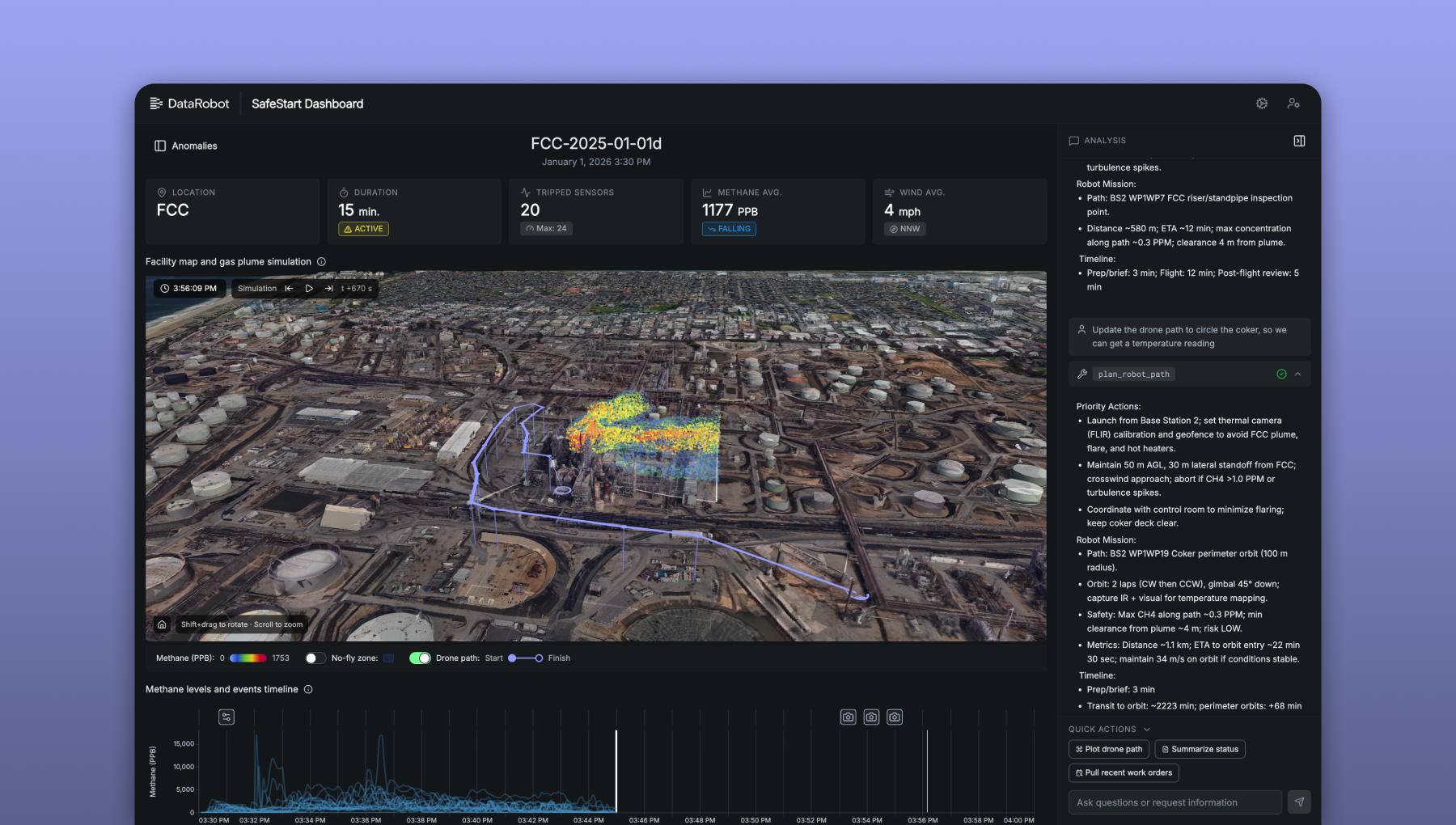
The physics and methane demo connected sensor information, simulation and mission planning. My Principal Product Designer designed and implemented the application’s dashboard, charts, chat and timeline. I encouraged him to build his ideas in code and worked with the technical lead on accountability and communication across DataRobot, NVIDIA and Chevron.
The demo showcased DataRobot’s agentic capabilities at GTC and in its Gartner submission, helping the company earn its third consecutive Magic Quadrant recognition. My contribution was supporting my Principal Product Designer’s broader role, interactive design direction, and coordinating the work with Product and Engineering leadership partners.
“
In simple terms, this improves safety by reducing reliance on manual, point-in-time checks and validating conditions continuously while work is underway. It helps reduce exposure, apply safety standards consistently, and deploy robotics more efficiently across our operations.”
Cari Armpriester
Facilities and Operations of the Future PM at Chevron
Customer Solutions
Agentic Business Planner: Released as an internal template and modules in August 2026
DataRobot’s Solutions team and app engineers built agent apps for customers and partners. My team’s job was to make them easier to use and trust. We shared DataRobot UI and brand instructions for AI coding tools, and Principal Product Designer worked inside each build.
SpendRite turns tariff, commodity, and supplier news into a daily risk report for an energy customer’s supply-chain team. Principal Product Designer redesign made that report the landing page, and the rebuilt app turned risk scores into a review queue with plain levels. It reached acceptance testing.
GeoTech came out of a three-week internal hackathon. Within a week of my Designer joining, the demo included his styling and UX proposals. Users approve each of its six phases.
On the experimental Agentic Business Planner, my designer and I shaped the user experience with the Senior Director of Product and engineers. My Designer created the initial designs, and we weighed in as engineers built them. His audit of the build logged 62 findings, and he worked with engineers on fixes.
Third, developing people through the work
Helping the team go from reactive to proactive
For the Chevron + NVIDIA app, I nudged one of my Principal Designers to stop waiting for direction and own both the design and front-end delivery. Once they stepped into that driver's seat, everything leveled up. They started syncing directly with Product and Engineering and used Claude Code and Gemini to build out the app themselves. My job shifted to backing them up and helping the team navigate delivery risks as they came up.
Around the same time, I was coaching my Product Design Lead to zoom out from their direct reports' projects and get sharper on prioritization and broader communication. We ended up co-leading our Munich offsite together, where we got the whole group aligned on planning, how we run critiques, and what our shared quality bar looks like.
What I would do differently
Agent Assist taught me to settle investment and sequencing earlier. Wider access to tools and methods also needs owners, maintenance and follow-through. I would make those commitments clearer before asking the team to move quickly.
Contributions
Product design direction, strategy, research, workshop and training facilitation
Collaborators
Workloads: Abdo Mahmoud (Product), Anna Horobchuk (Product Designer), Aliona Kyrychenko (Product Design Lead), Adam Alpire (SWE), Bogdan Klichuk (Principal SWE), Bohdan Feniak (Dir., Eng), Eilis Delaney (UX Research Lead), Anton Berezhinsky (SWE), Pavlo Kyrychenko (SWE), Venkat Bala (Principal SWE)
Solutions: Brett Rowley (Principal Designer), Luke Shulman (Director, Vanguard), Snizhana Mamchak (Principal SWE)
Agent Assist: Amber Bennoui (Product), Corinne Schillizzi (Principal Product Designer), Carson Gee (Sr. Principal SWE), Colleen Wilhide (Product), Eilis Delaney (UX Research Lead), Jeremy Johnson (SWE), Jyothi Nookula (Sr. Dir., Product), Marcus Braun (SVP, DevelopmentNadiia Steblivets (Principal Designer), Nate Daly (Product), Shreya Agrawal (Product), Viktor Borshchak (SWE),
Leadership: Amit Purohit (CTO), Prajakta Damle (SVP, Product), Ramyanshu Datta (VP, Product), Vaibhav Chourasia (VP, Eng), Venky Veeraraghavan (CPO),

DataRobot
Leading design across a complex AI platform
Role: Head of Design
DataRobot is an Enterprise AI platform that helps technical teams build, deploy and manage predictive models, generative AI and agents. The product spans development, evaluation, deployment and ongoing monitoring, with both visual and code-based workflows. Making those parts understandable together was central to our work.
As Head of Design at DataRobot, I led an eight-person team working across predictive AI, agents, governance and developer tools. I set design direction and standards, supported design owners, and partnered with the CPO, CTO and VPs of Product and Engineering on product strategy.
Our challenge was to make development, evaluation, deployment and monitoring work as a coherent experience for technical teams at Chevron, Dell, Geico, NVIDIA, and others.
Setting direction across the platform
I’d only been at DataRobot a few months when we had our leadership summit in Boston back in April 2026. Going into it, I’d been digging through a lot of UX research and talking with colleagues, and one thing kept standing out: we really needed to prioritize reliability for our agents. Once I brought that up, the group pretty quickly agreed. We realized we weren't giving people a smooth, stable, reliable way to build and run agentic apps on DataRobot yet.
Getting on the same page about that basically set my team’s direction from there. It’s what pushed us to focus on Agent Assist, Manage at Scale, Workloads for inference deployment, and Token Grid for inference management, along with making some much-needed improvements to the trial experience.
Our DevEx work covered agent authoring and making Agent Assist more reliable.
We also worked on using AI tools to speed up design and development. The Workloads and Agent Assist examples below show how we carried this work forward.
After Workloads reached GA, I asked the team to revisit usability findings that had been deferred during the release. That work led to fewer build steps and visible build logs.
How I led the work
First, I built up a design capability beyond the team
With shared prototyping tools, hands-on training, and open research, colleagues didn't have to wait on UX to explore new ideas
LEFT: Functional prototype for Tracing built using Claude Code + DR-UI styles. RIGHT: A DataRobot-branded starting point for AI-assisted prototyping, built using the team’s DR-UI design system.
Enable others to build:A shared foundation for AI-assisted design
80%
Designers’ estimate of time saved from concept to handoff with AI skills and design tools
In my first weeks I brought the team together for a summit. We agreed on our principles: deliver user value, make intentional decisions, and hold a high bar for aesthetics, behavior, interaction, and research rigor. We named what helps us succeed, what burns people out, and how to defend standards under deadline pressure. Then we set our 2026 priorities: workload and deployment management, code-to-workload capabilities, and better observability.
Next, I brought AI tools into our practice (Claude Code, Figma Make, Cursor, Claude Design) so we could explore more ideas and put prototypes in front of people sooner. I packaged DR-UI, our shadcn/ui-based design system, as a design.md, AI skills, reference files, and guides, so designers, researchers, PMs, engineers, and the Solutions team could build consistent, on-brand apps. Designers estimated it cut design time up to 80% from concept to handoff. In 2026, we added 18 components to DR-UI.
UX Education:
Teach the methods as well as the tools
With my Principal Product Designer and Product Researcher Lead, I ran UX training for the Solutions team on design, research, and tools. Colleagues building customer solutions could then use the methods themselves, instead of waiting for us to review each app.
Research enablement: Make research possible beyond the research team
My UX Research Lead and I rolled out User Interviews, Dovetail, and Ballpark alongside hands-on training, giving PMs and engineers what they needed to run moderated and unmoderated studies without a researcher in every room.
The point wasn't just giving teams access to new software; it was making research a regular part of their workflow. Good studies still come down to asking the right question and turning user behavior into a product decision, so we made sure people knew how to do both.
Second, the work we did together
Across all projects, I set direction, reviewed prototypes, supported design owners and worked through decisions with Product and Engineering.
Agent Assist
Released February 2026
<5mins
Prototype to production an AI agent using Agent Assist in <5 mins (down from 15).
Agent Assist helps developers plan, code, and deploy AI agents through natural language conversation. Two pieces shipped while I led design and research: the CLI experience, and the Local Experimentation UI. Agent Assist launched in preview in February, and Local Experimentation followed in June.
My team researched the two. Our designers worked on Local Experimentation and agent tracing. I set direction, reviewed the work, and partnered with Product and Engineering.
Research by my UX Research Lead, found confusion and long waits. One Agent Assist run took more than 15 minutes without explaining what was happening.
We took those findings to Product and Engineering. Engineering added stage-by-stage explanations of how the Starter App was being built, plus a prompt asking whether users wanted to run a simulation before deploying.
Separately, after the Workloads API release, we saw some runs go from starting Agent Assist to a usable Agentic Starter App deployed on DataRobot in less than five minutes, which was a significant improvement.
“
...it was pretty fast but one real pro is it gives you a lot of flexibility on what you’re doing, and a lot of visibility on exactly what it’s thinking. I was especially impressed just seeing this plan and every thing it was laying out. It provided a lot more detail and rational assumptions than I expected.”
P2_Full Stack Dev
May ‘26
Workloads: Continuity through delivery
Released July 2026
Workloads is a stable, managed identity that hosts containerized AI services and custom application code (such as AI agents, models, frontends, or custom tools) directly on the DataRobot platform. It bridges the gap between local development and enterprise-grade deployment. My Product Design Lead on my team, set the early design. When they went on planned leave, my Principal Product Designer covered the transition and one of my Product Designers became the new design lead.
I backed the new design lead’s ownership and pushed for research with my UX Research Lead. They expanded the failure flows and took the design through sign-off. All our lighthouse customers, including NVIDIA, Dell, Aon, Chevron, and GEICO, use it to deploy predictive models and agent pipelines on DataRobot.
50-90%
Faster than legacy custom model deployment
6.3x
Faster running a prebuilt image vs. legacy
Chevron + NVIDIA: SafeStart
Released February 2026Showcased at GTC 2026
The physics and methane demo connected sensor information, simulation and mission planning. My Principal Product Designer designed and implemented the application’s dashboard, charts, chat and timeline. I encouraged him to build his ideas in code and worked with the technical lead on accountability and communication across DataRobot, NVIDIA and Chevron.
The demo showcased DataRobot’s agentic capabilities at GTC and in its Gartner submission, helping the company earn its third consecutive Magic Quadrant recognition. My contribution was supporting my Principal Product Designer’s broader role, interactive design direction, and coordinating the work with Product and Engineering leadership partners.
“
In simple terms, this improves safety by reducing reliance on manual, point-in-time checks and validating conditions continuously while work is underway. It helps reduce exposure, apply safety standards consistently, and deploy robotics more efficiently across our operations.”
Cari Armpriester
Facilities and Operations of the Future PM at Chevron
Customer Solutions
Agentic Business Planner: Released as an internal template and modules in August 2026
DataRobot’s Solutions team and app engineers built agent apps for customers and partners. My team’s job was to make them easier to use and trust. We shared DataRobot UI and brand instructions for AI coding tools, and Principal Product Designer worked inside each build.
SpendRite turns tariff, commodity, and supplier news into a daily risk report for an energy customer’s supply-chain team. Principal Product Designer redesign made that report the landing page, and the rebuilt app turned risk scores into a review queue with plain levels. It reached acceptance testing.
GeoTech came out of a three-week internal hackathon. Within a week of my Designer joining, the demo included his styling and UX proposals. Users approve each of its six phases.
On the experimental Agentic Business Planner, my designer and I shaped the user experience with the Senior Director of Product and engineers. My Designer created the initial designs, and we weighed in as engineers built them. His audit of the build logged 62 findings, and he worked with engineers on fixes.
Third, developing people through the work
Helping the team go from reactive to proactive
For the Chevron + NVIDIA app, I nudged one of my Principal Designers to stop waiting for direction and own both the design and front-end delivery. Once they stepped into that driver's seat, everything leveled up. They started syncing directly with Product and Engineering and used Claude Code and Gemini to build out the app themselves. My job shifted to backing them up and helping the team navigate delivery risks as they came up.
Around the same time, I was coaching my Product Design Lead to zoom out from their direct reports' projects and get sharper on prioritization and broader communication. We ended up co-leading our Munich offsite together, where we got the whole group aligned on planning, how we run critiques, and what our shared quality bar looks like.
What I would do differently
Agent Assist taught me to settle investment and sequencing earlier. Wider access to tools and methods also needs owners, maintenance and follow-through. I would make those commitments clearer before asking the team to move quickly.
Contributions
Product design direction, strategy, research, workshop and training facilitation
Collaborators
Workloads: Abdo Mahmoud (Product), Anna Horobchuk (Product Designer), Aliona Kyrychenko (Product Design Lead), Adam Alpire (SWE), Bogdan Klichuk (Principal SWE), Bohdan Feniak (Dir., Eng), Eilis Delaney (UX Research Lead), Anton Berezhinsky (SWE), Pavlo Kyrychenko (SWE), Venkat Bala (Principal SWE)
Solutions: Brett Rowley (Principal Designer), Luke Shulman (Director, Vanguard), Snizhana Mamchak (Principal SWE)
Agent Assist: Amber Bennoui (Product), Corinne Schillizzi (Principal Product Designer), Carson Gee (Sr. Principal SWE), Colleen Wilhide (Product), Eilis Delaney (UX Research Lead), Jeremy Johnson (SWE), Jyothi Nookula (Sr. Dir., Product), Marcus Braun (SVP, DevelopmentNadiia Steblivets (Principal Designer), Nate Daly (Product), Shreya Agrawal (Product), Viktor Borshchak (SWE),
Leadership: Amit Purohit (CTO), Prajakta Damle (SVP, Product), Ramyanshu Datta (VP, Product), Vaibhav Chourasia (VP, Eng), Venky Veeraraghavan (CPO),

DataRobot
Leading design across a complex AI platform
Role: Head of Design
DataRobot is an Enterprise AI platform that helps technical teams build, deploy and manage predictive models, generative AI and agents. The product spans development, evaluation, deployment and ongoing monitoring, with both visual and code-based workflows. Making those parts understandable together was central to our work.
As Head of Design at DataRobot, I led an eight-person team working across predictive AI, agents, governance and developer tools. I set design direction and standards, supported design owners, and partnered with the CPO, CTO and VPs of Product and Engineering on product strategy.
Our challenge was to make development, evaluation, deployment and monitoring work as a coherent experience for technical teams at Chevron, Dell, Geico, NVIDIA, and others.
Setting direction across the platform
I’d only been at DataRobot a few months when we had our leadership summit in Boston back in April 2026. Going into it, I’d been digging through a lot of UX research and talking with colleagues, and one thing kept standing out: we really needed to prioritize reliability for our agents. Once I brought that up, the group pretty quickly agreed. We realized we weren't giving people a smooth, stable, reliable way to build and run agentic apps on DataRobot yet.
Getting on the same page about that basically set my team’s direction from there. It’s what pushed us to focus on Agent Assist, Manage at Scale, Workloads for inference deployment, and Token Grid for inference management, along with making some much-needed improvements to the trial experience.
Our DevEx work covered agent authoring and making Agent Assist more reliable.
We also worked on using AI tools to speed up design and development. The Workloads and Agent Assist examples below show how we carried this work forward.
After Workloads reached GA, I asked the team to revisit usability findings that had been deferred during the release. That work led to fewer build steps and visible build logs.
How I led the work
First, I built up a design capability beyond the team
With shared prototyping tools, hands-on training, and open research, colleagues didn't have to wait on UX to explore new ideas
LEFT: Functional prototype for Tracing built using Claude Code + DR-UI styles. RIGHT: A DataRobot-branded starting point for AI-assisted prototyping, built using the team’s DR-UI design system.
Enable others to build:A shared foundation for AI-assisted design
80%
Designers’ estimate of time saved from concept to handoff with AI skills and design tools
In my first weeks I brought the team together for a summit. We agreed on our principles: deliver user value, make intentional decisions, and hold a high bar for aesthetics, behavior, interaction, and research rigor. We named what helps us succeed, what burns people out, and how to defend standards under deadline pressure. Then we set our 2026 priorities: workload and deployment management, code-to-workload capabilities, and better observability.
Next, I brought AI tools into our practice (Claude Code, Figma Make, Cursor, Claude Design) so we could explore more ideas and put prototypes in front of people sooner. I packaged DR-UI, our shadcn/ui-based design system, as a design.md, AI skills, reference files, and guides, so designers, researchers, PMs, engineers, and the Solutions team could build consistent, on-brand apps. Designers estimated it cut design time up to 80% from concept to handoff. In 2026, we added 18 components to DR-UI.
UX Education:
Teach the methods as well as the tools
With my Principal Product Designer and Product Researcher Lead, I ran UX training for the Solutions team on design, research, and tools. Colleagues building customer solutions could then use the methods themselves, instead of waiting for us to review each app.
Research enablement: Scaling research beyond the research team
My UX Research Lead and I rolled out User Interviews, Dovetail, and Ballpark alongside hands-on training, giving PMs and engineers what they needed to run moderated and unmoderated studies without a researcher in every room.
The point wasn't just giving teams access to new software; it was making research a regular part of their workflow. Good studies still come down to asking the right question and turning user behavior into a product decision, so we made sure people knew how to do both.
Second, the work we did together
Across all projects, I set direction, reviewed prototypes, supported design owners and worked through decisions with Product and Engineering.
Agent Assist
Released February 2026
<5mins
Prototype to production an AI agent using Agent Assist in <5 mins (down from 15).
Agent Assist helps developers plan, code, and deploy AI agents through natural language conversation. Two pieces shipped while I led design and research: the CLI experience, and the Local Experimentation UI. Agent Assist launched in preview in February, and Local Experimentation followed in June.
My team researched the two. Our designers worked on Local Experimentation and agent tracing. I set direction, reviewed the work, and partnered with Product and Engineering.
Research by my UX Research Lead, found confusion and long waits. One Agent Assist run took more than 15 minutes without explaining what was happening.
We took those findings to Product and Engineering. Engineering added stage-by-stage explanations of how the Starter App was being built, plus a prompt asking whether users wanted to run a simulation before deploying.
Separately, after the Workloads API release, we saw some runs go from starting Agent Assist to a usable Agentic Starter App deployed on DataRobot in less than five minutes, which was a significant improvement.
“
...it was pretty fast but one real pro is it gives you a lot of flexibility on what you’re doing, and a lot of visibility on exactly what it’s thinking. I was especially impressed just seeing this plan and every thing it was laying out. It provided a lot more detail and rational assumptions than I expected.”
P2_Full Stack Dev
May ‘26
Workloads: Continuity through delivery
Released July 2026
Workloads is a stable, managed identity that hosts containerized AI services and custom application code (such as AI agents, models, frontends, or custom tools) directly on the DataRobot platform. It bridges the gap between local development and enterprise-grade deployment. My Product Design Lead on my team, set the early design. When they went on planned leave, my Principal Product Designer covered the transition and one of my Product Designers became the new design lead.
I backed the new design lead’s ownership and pushed for research with my UX Research Lead. They expanded the failure flows and took the design through sign-off. All our lighthouse customers, including NVIDIA, Dell, Aon, Chevron, and GEICO, use it to deploy predictive models and agent pipelines on DataRobot.
50-90%
Faster than legacy custom model deployment
6.3x
Faster running a prebuilt image vs. legacy
Chevron + NVIDIA: SafeStart
Released February 2026Showcased at GTC 2026
The physics and methane demo connected sensor information, simulation and mission planning. My Principal Product Designer designed and implemented the application’s dashboard, charts, chat and timeline. I encouraged him to build his ideas in code and worked with the technical lead on accountability and communication across DataRobot, NVIDIA and Chevron.
The demo showcased DataRobot’s agentic capabilities at GTC and in its Gartner submission, helping the company earn its third consecutive Magic Quadrant recognition. My contribution was supporting my Principal Product Designer’s broader role, interactive design direction, and coordinating the work with Product and Engineering leadership partners.
“
In simple terms, this improves safety by reducing reliance on manual, point-in-time checks and validating conditions continuously while work is underway. It helps reduce exposure, apply safety standards consistently, and deploy robotics more efficiently across our operations.”
Cari Armpriester
Facilities and Operations of the Future PM at Chevron
Customer Solutions
Agentic Business Planner: Released as an internal template and modules in August 2026
DataRobot’s Solutions team and app engineers built agent apps for customers and partners. My team’s job was to make them easier to use and trust. We shared DataRobot UI and brand instructions for AI coding tools, and Principal Product Designer worked inside each build.
SpendRite turns tariff, commodity, and supplier news into a daily risk report for an energy customer’s supply-chain team. Principal Product Designer redesign made that report the landing page, and the rebuilt app turned risk scores into a review queue with plain levels. It reached acceptance testing.
GeoTech came out of a three-week internal hackathon. Within a week of my Designer joining, the demo included his styling and UX proposals. Users approve each of its six phases.
On the experimental Agentic Business Planner, my designer and I shaped the user experience with the Senior Director of Product and engineers. My Designer created the initial designs, and we weighed in as engineers built them. His audit of the build logged 62 findings, and he worked with engineers on fixes.
Third, developing people through the work
Helping the team go from reactive to proactive
For the Chevron + NVIDIA app, I nudged one of my Principal Designers to stop waiting for direction and own both the design and front-end delivery. Once they stepped into that driver's seat, everything leveled up. They started syncing directly with Product and Engineering and used Claude Code and Gemini to build out the app themselves. My job shifted to backing them up and helping the team navigate delivery risks as they came up.
Around the same time, I was coaching my Product Design Lead to zoom out from their direct reports' projects and get sharper on prioritization and broader communication. We ended up co-leading our Munich offsite together, where we got the whole group aligned on planning, how we run critiques, and what our shared quality bar looks like.
What I would do differently
Agent Assist taught me to settle investment and sequencing earlier. Wider access to tools and methods also needs owners, maintenance and follow-through. I would make those commitments clearer before asking the team to move quickly.
Contributions
Product design direction, strategy, research, workshop and training facilitation
Collaborators
Workloads: Abdo Mahmoud (Product), Adam Alpire (SWE), Aliona Kyrychenko (Product Design Lead), Anna Horobchuk (Product Designer), Anton Berezhinsky (SWE), Bogdan Klichuk (Principal SWE), Bohdan Feniak (Dir., Eng), Eilis Delaney (UX Research Lead), Pavlo Kyrychenko (SWE), Venkat Bala (Principal SWE)
Solutions: Brett Rowley (Principal Designer), Luke Shulman (Director, Vanguard), Snizhana Mamchak (Principal SWE)
Agent Assist: Amber Bennoui (Product), Corinne Schillizzi (Principal Product Designer), Carson Gee (Sr. Principal SWE), Colleen Wilhide (Product), Eilis Delaney (UX Research Lead), Jeremy Johnson (SWE), Jyothi Nookula (Sr. Dir., Product), Marcus Braun (SVP, DevelopmentNadiia Steblivets (Principal Designer), Nate Daly (Product), Shreya Agrawal (Product), Viktor Borshchak (SWE),
Leadership: Amit Purohit (CTO), Prajakta Damle (SVP, Product), Ramyanshu Datta (VP, Product), Vaibhav Chourasia (VP, Eng), Venky Veeraraghavan (CPO),