


TwelveLabs
Building Video Tools from Powerful Models
Role: Lead Designer
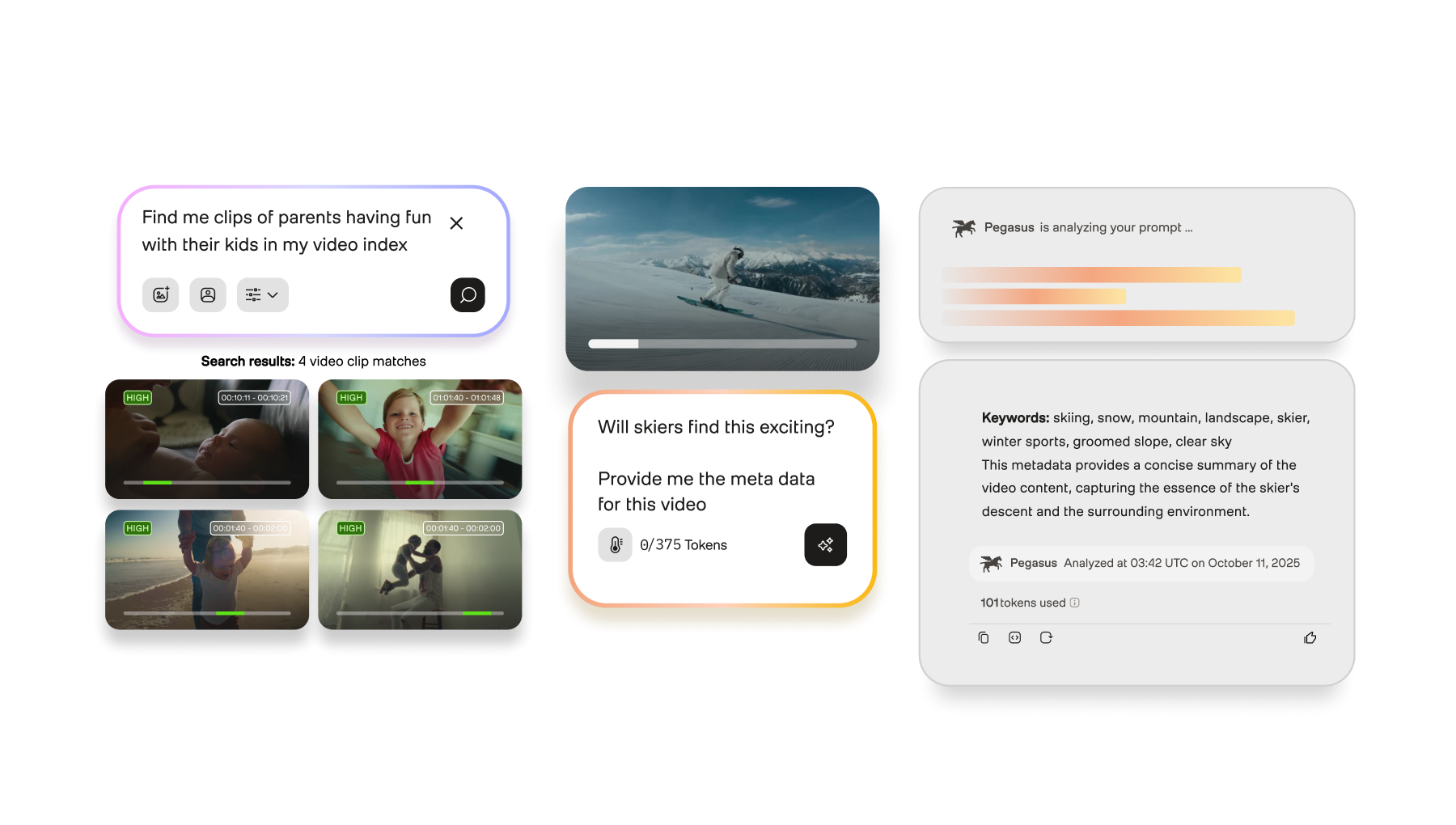
From April 2024 to December 2025, I led all design at TwelveLabs (product, marketing, UX research, and strategy) while the company grew from Series A to Series B. I made the core product clearer, built the team, and tested new workflows for video professionals.
TwelveLabs is the world's most powerful video intelligence platform for enterprises. We developed video-native multimodal foundation models designed to see, hear, and understand video content like humans do. Instead of analyzing videos as isolated, frame-by-frame static images, TwelveLabs' models process video holistically by interpreting motion, timing, speech, audio, and visual context together.
TwelveLabs builds video-understanding models: Marengo for search and Pegasus for analysis. Developers tried them in Playground, our web app, and sales used it for client demos. What I discovered through onboarding and what UX Research later showed, was that users struggled to understand what the models could do, which slowed adoption. It also showed editors and producers were drawn to the platform, but Playground wasn’t built for them.
We aspired to change the way humans use, explore, and interact with video content. Bringing next-level intelligence to video-centric workflows, opening new paths and possibilities for progress. We’re making AI that understands like humans, to help human create what's next.
TwelveLabs recruited me to bring maturity and structure to their product team and modernize their brand to be more attractive to Enterprise customers and streamline UI to visualize our APIs so that developers could use our platform. That was the stated problem. The actual problem was larger and more systemic.
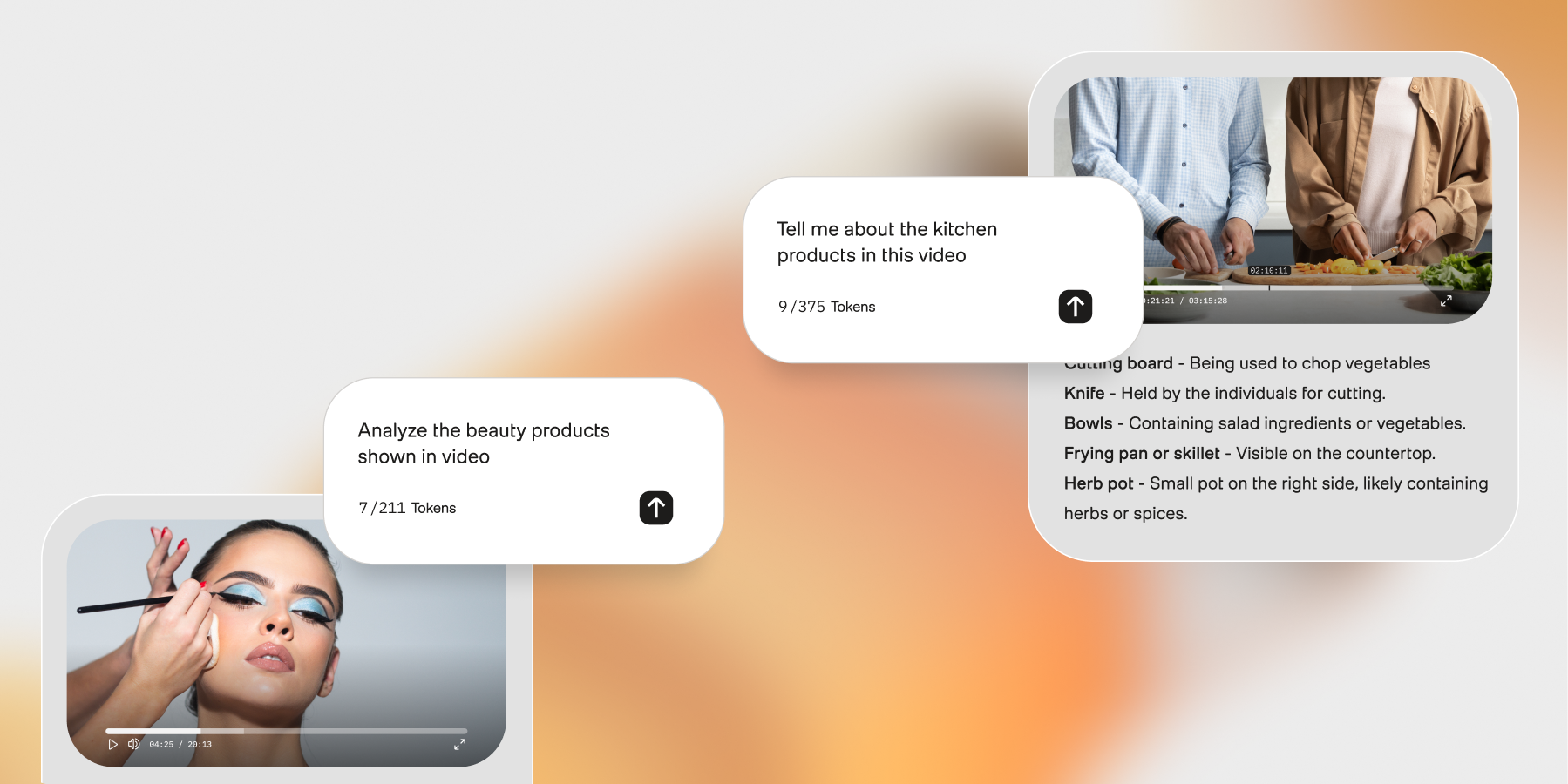
Navigating Change:
How I shaped collaboration between the product, design, and engineering teams
Video AI is tough to explain, especially when you're working in a space without many good examples to point to. Almost no one was searching and analyzing video well yet, so users didn't have an obvious mental model for it. Features like Search and Analyze usually took a live demo before they really clicked. On top of that, people saw a prompt box and expected it to generate new visuals, not return text about an existing video. Internally, all that upfront exploration created real tension. Leadership, product, and engineering felt design was running too many iterations and slowing down velocity.
To fix the bottleneck, I cut our cycles down to a single round of feedback and iteration. Designers stopped waiting around for sign-off. Instead, they had the autonomy to make the call themselves and hand work straight off to engineering.
From there, I partnered with design, product, and engineering to build shared roadmaps so we could stop reacting and start getting ahead of the work. The AI space was moving at breakneck speed, and staying proactive took steady effort.
That shift really smoothed out how we collaborated across teams. Eventually, as the workload grew, I brought in contractors to cover marketing and event design so I could protect my product designer's time.
40%
Our estimate, from Linear burn rates, of how much one feedback round cut approval cycles, which helped increase velocity
Built the team and the Design and Research practice
I scaled our distributed team from just me and one designer up to two full-time reports and nine contractors. Because we were still a Series A startup, I had to be thoughtful and creative about how we grew. The goal was to stay lean, make smart micro-investments in design and research, and bring in specialized help right when we needed it.
One of my first moves was bringing in Shannon, our researcher, and together we built the research practice from scratch. To stretch our design and engineering muscle without bloating full-time headcount, I also partnered with Pentagram (design ), Rubicon (development), and Toptal (staffing design and development), and teamed up with Homebrew to build an Adobe Premiere Pro extension. Behind the scenes, I worked closely with our cofounders and Head of Finance to lock down budgets, and partnered with our outside counsel at Fenwick and later our Head of Legal to get all the SOWs and contracts across the finish line.
With a distributed group and a lot of moving parts, keeping everyone aligned mattered. We hosted weekly design share-outs where PMs, the CTO, and occasionally the CEO would drop in to see progress and weigh in. We welcomed that feedback and used it to help prioritize, and I sent out a monthly design newsletter so the rest of the company could see what we were building.


Preparing TwelveLabs
for enterprise growth
Our design team partnered with Product Management, Engineering, Research Science, GTM, and Sales to identify where customer pain points, usability, and accessibility were limiting the product experience and sales opportunities. Together, we prioritized improvements, scoped the work with Engineering, and established an implementation roadmap.
The work spanned TwelveLabs’ brand, Playground developer platform, model evaluations, and a new product: Rodeo.
Leading the TwelveLabs rebrand
I led TwelveLabs’ rebrand as the company matured beyond Series A and prepared for its next stage of growth. I hired and partnered with Pentagram, whose “video as volume” concept took shape through threaded diagrams, purposeful motion, and a modular horse symbol.
The goal was to communicate technical depth and clarity while building enterprise confidence across media and entertainment, sports, advertising and marketing, technology, and government.
The rebrand won a Creative Review Grand Prix and listed as a Top 25 rebrand for 2025.
To learn more, check out the TwelveLabs Rebrand Case Study.
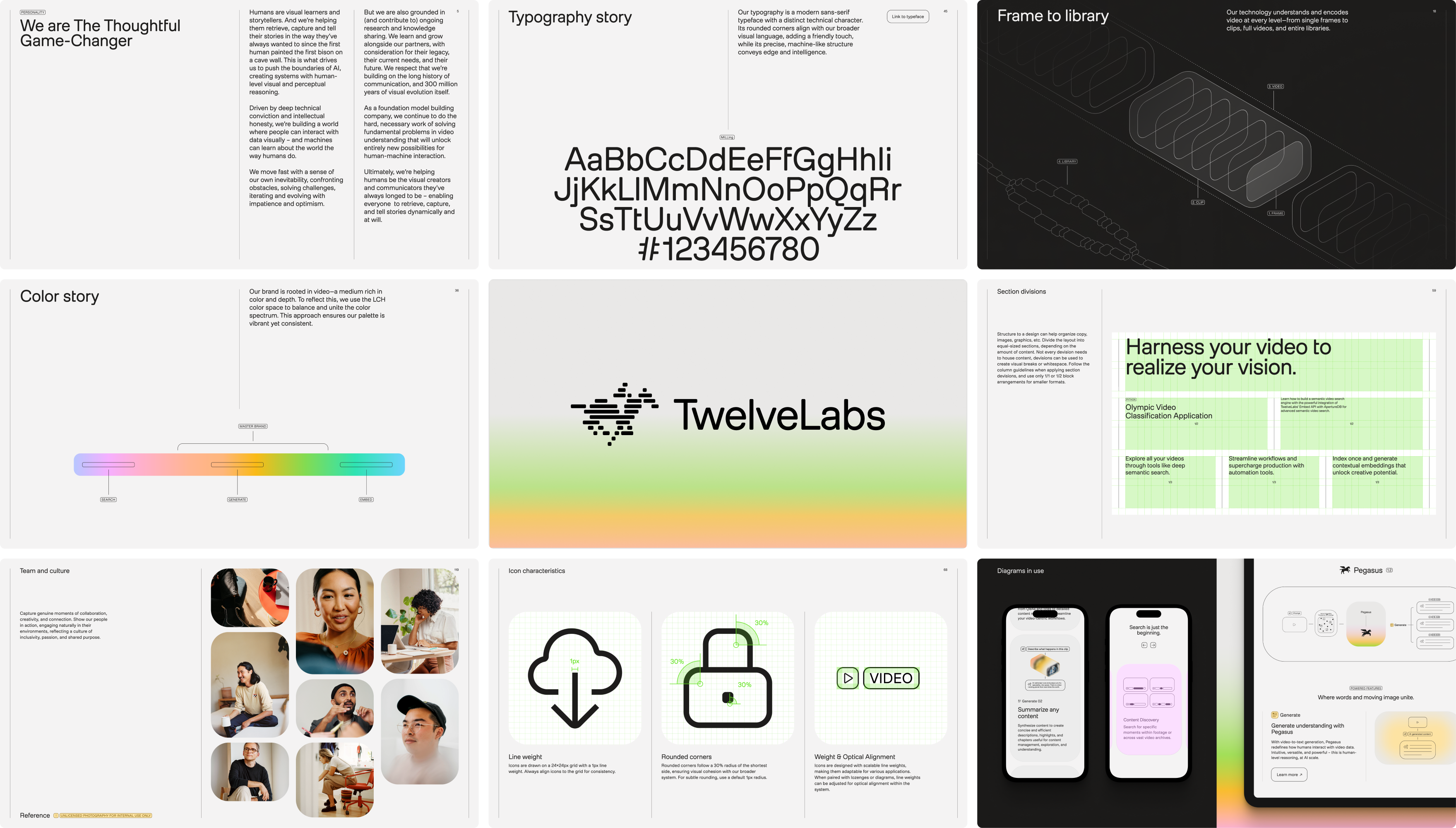
View rebrand Case Study
Making video AI easier to evaluate, trust, and use
I partnered with leadership, Product, and Research Science to evaluate Marengo (Search) and Pegasus (Analyze) against customer needs. We combined UX research, sales feedback, and model evaluations to identify capability gaps, assess readiness, and inform roadmap priorities.
In the Developer Playground tool, I challenged the original name “Generate” because it suggested creating video, while the feature produced text from video, such as summaries and scene descriptions. I also suspected that the lack of onboarding left users unsure where to start. Our developer-first approach compounded the problem for interested video professionals, including editors and producers, who struggled without a technical background.
I brought in UX research to test these concerns. Research confirmed confusion around the feature’s purpose and difficulty getting started. I led my team through workshops, prototypes, and further research to redesign the experience, rename it Analyze, and introduce onboarding and sample prompts that helped users reach their first result.
I led the redesign of our layout and information flow. Early on with Analyze, we tried a standard chat interface, which quickly ran into a wall: people needed to watch and interact with the video even after they sent a prompt. Putting the video and chat side by side solved that. The video stayed as a live reference while users asked questions and worked through the responses.
Testing also uncovered a trust issue. Whenever the system went quiet while processing, users assumed it had broken and canceled tasks that were actually working fine. To fix that, we designed clear progress states showing each step the agent was taking, giving people the confidence to wait it out, step in, or redirect. When we brought back users who already knew Analyze, they immediately noticed and appreciated those subtle touches.
That overhaul paid off. After the 1.2 model release and UI/UX update, Analyze (Pegasus) overtook Search (Marengo) in monthly active users across both the Playground and API in April and May 2025. Around the same time, we rolled out secure login and enterprise admin tools to make it much easier for larger teams to evaluate and adopt TwelveLabs.
Partnering with customers
Among the customers I partnered with at TwelveLabs, MLSE and the NFL stood out for their insights into how video AI could support producers, editors, and broadcasters. Their input helped us connect model capabilities with production needs and shape the direction of TwelveLabs’ agentic framework.
With MLSE, I facilitated a workshop in Toronto that brought teams together to map their production workflows, identify friction, and explore new uses for AI. Some participants were hesitant about adoption. During the workshop, we learned that MLSE had reduced highlight creation from 16 hours to nine minutes using TwelveLabs. The activities I facilitated helped the team see how those time savings could translate into more creative work and personalized fan content, making the value of adopting TwelveLabs more tangible. MLSE later demonstrated the workflow at AWS Summit Toronto.
With the NFL, we explored faster footage discovery, rough cut assembly, and integration with Adobe Premiere. We also invited NFL partners to sponsored hackathons in Los Angeles, where they shared their workflows with developers.
The sessions exposed practical barriers to adoption: inaccurate footage retrieval, unpredictable results, and interfaces that relied too heavily on prompts. These findings informed recommendations for clearer interactive controls, model evaluation for accuracy and reliability, and workflows that fit existing editing tools. The work clarified priorities for further development and testing with customers, from player recognition to reliable retrieval of historical footage.
Taking Rodeo from concept to MVP
In the summer of 2025, I moved to Los Angeles for three months to take Rodeo from an early concept to a working MVP. It’s an AI creative copilot and video editor built for video pros, and I owned everything from product strategy and interaction design to prototyping, research, and evaluations. Partnering with cofounder and GTM leader Soyoung Lee, I guided and mentored our product and engineering team to turn TwelveLabs’ video understanding technology into a creative copilot for video professionals.
Research with producers, editors, and teams from American Idol, The Weakest Link, the NFL, MLSE, and Amazon Prime Sports shaped Rodeo’s experience and TwelveLabs’ video model priorities.
The MVP introduced workflows beyond Playground, including assembling video through prompts and organizing search results by sentiment, expanding how creative teams could use TwelveLabs.
Soyoung credited Rodeo’s MVP demos as a key driver behind Paramount/CBS signing a seven-figure deal with TwelveLabs. When I moved on to DataRobot, the team had both a working MVP and clear customer research to guide what came next.
What changed
My team’s work contributed to product led growth in 2025
7.5x
User growth
8.6x
Company ARR
49%
Activation lift
Growth from sign-ups
93×
Video Uploads
“
TwelveLabs has developed a powerful and user-friendly technology that allows users to ask questions about videos and receive answers as if by magic!”
Jorge Torres
Co-Founder and CEO, MindsDB
“
Building with TwelveLabs was an easy and powerful way to enhance our video datasets. Integration with FiftyOne was made simple with their excellent documentation and tutorials.”
JDaniel Gural
Machine Learning Evangelist, Voxel51
“
TwelveLabs' Rodeo is a clear example of how AI could actually make sense in entertainment. It has the potential to lower the barrier of entry for new creators and filmmakers and speed up the production process for professionals.”
The DeepView
How TwelveLabs is fighting slop with AI“
For producers, editors, creative directors, documentarians, directors, and more, Rodeo is like having an assistant who has watched everything in their video archive before serving it up within the workflow. This lets users spend more time creating and less time searching.”
Contributions
Product design direction, strategy, research, workshop facilitation, front-end development
Collaborators
Aditya Sankhe (Staff Product Designer), Adrienne Brabant (Chief of Staff), Aiden Lee (CTO + Cofounder), Anthony Giuliani (COO), Brian Lese (CFO), EK Yoon (Product Manager), Esther Kim (Dir., Eng), Dan Germain (GTM), Dahyun Kim (ML Research Scientist), Jae Lee (CEO + Cofounder), Jamal Jackson (SWE), James Gu (Growth), James Le (Head of DevEx), Jenna Kang (Product Design), Junsik Shim (SWE), Kingston Yip (SWE), Maninder Saini (Head of Growth), Manish Maheshwari (Product), Meryl Hu (Lead SWE), Stu Stewart (Dir., Eng), Mohit varikut (SWE intern), Nicholas Mandel (SWE), Paritosh Mohan (VP, Eng), Ryan Khurana (Product), Shannon Bator (UX Researcher), Simon Lecointe (Head of Field Eng), Soyoung Lee (Head of GTM + Cofounder), Sue Kim (GTM),Sunny Nguyen (Group Product Manager), Travis Couture (Head of Product / Solutions), Wonjae Kim (Lead Research Scientist), Yeonhoo Park (SWE)

TwelveLabs
Building Video Tools from Powerful Models
Role: Lead Designer
From April 2024 to December 2025, I led all design at TwelveLabs (product, marketing, UX research, and strategy) while the company grew from Series A to Series B. I made the core product clearer, built the team, and tested new workflows for video professionals.
TwelveLabs is the world's most powerful video intelligence platform for enterprises. We developed video-native multimodal foundation models designed to see, hear, and understand video content like humans do. Instead of analyzing videos as isolated, frame-by-frame static images, TwelveLabs' models process video holistically by interpreting motion, timing, speech, audio, and visual context together.
TwelveLabs builds video-understanding models: Marengo for search and Pegasus for analysis. Developers tried them in Playground, our web app, and sales used it for client demos. What I discovered through onboarding and what UX Research later showed, was that users struggled to understand what the models could do, which slowed adoption. It also showed editors and producers were drawn to the platform, but Playground wasn’t built for them.
We aspired to change the way humans use, explore, and interact with video content. Bringing next-level intelligence to video-centric workflows, opening new paths and possibilities for progress. We’re making AI that understands like humans, to help human create what's next.
TwelveLabs recruited me to bring maturity and structure to their product team and modernize their brand to be more attractive to Enterprise customers and streamline UI to visualize our APIs so that developers could use our platform. That was the stated problem. The actual problem was larger and more systemic.
Navigating Change:
How I shaped collaboration between the product, design, and engineering teams
Video AI is tough to explain, especially when you're working in a space without many good examples to point to. Almost no one was searching and analyzing video well yet, so users didn't have an obvious mental model for it. Features like Search and Analyze usually took a live demo before they really clicked. On top of that, people saw a prompt box and expected it to generate new visuals, not return text about an existing video. Internally, all that upfront exploration created real tension. Leadership, product, and engineering felt design was running too many iterations and slowing down velocity.
40%
Our estimate, from Linear burn rates, of how much one feedback round cut approval cycles, which helped increase velocity
To fix the bottleneck, I cut our cycles down to a single round of feedback and iteration. Designers stopped waiting around for sign-off. Instead, they had the autonomy to make the call themselves and hand work straight off to engineering.
From there, I partnered with design, product, and engineering to build shared roadmaps so we could stop reacting and start getting ahead of the work. The AI space was moving at breakneck speed, and staying proactive took steady effort.
That shift really smoothed out how we collaborated across teams. Eventually, as the workload grew, I brought in contractors to cover marketing and event design so I could protect my product designer's time.
Built the team and the Design and Research practice
I scaled our distributed team from just me and one designer up to two full-time reports and nine contractors. Because we were still a Series A startup, I had to be thoughtful and creative about how we grew. The goal was to stay lean, make smart micro-investments in design and research, and bring in specialized help right when we needed it.
One of my first moves was bringing in Shannon, our researcher, and together we built the research practice from scratch. To stretch our design and engineering muscle without bloating full-time headcount, I also partnered with Pentagram (design ), Rubicon (development), and Toptal (staffing design and development), and teamed up with Homebrew to build an Adobe Premiere Pro extension. Behind the scenes, I worked closely with our cofounders and Head of Finance to lock down budgets, and partnered with our outside counsel at Fenwick and later our Head of Legal to get all the SOWs and contracts across the finish line.
With a distributed group and a lot of moving parts, keeping everyone aligned mattered. We hosted weekly design share-outs where PMs, the CTO, and occasionally the CEO would drop in to see progress and weigh in. We welcomed that feedback and used it to help prioritize, and I sent out a monthly design newsletter so the rest of the company could see what we were building.


Preparing TwelveLabs
for enterprise growth
Our design team partnered with Product Management, Engineering, Research Science, GTM, and Sales to identify where customer pain points, usability, and accessibility were limiting the product experience and sales opportunities. Together, we prioritized improvements, scoped the work with Engineering, and established an implementation roadmap.
The work spanned TwelveLabs’ brand, Playground developer platform, model evaluations, and a new product: Rodeo.
Leading the TwelveLabs rebrand
I led TwelveLabs’ rebrand as the company matured beyond Series A and prepared for its next stage of growth. I hired and partnered with Pentagram, whose “video as volume” concept took shape through threaded diagrams, purposeful motion, and a modular horse symbol.
The goal was to communicate technical depth and clarity while building enterprise confidence across media and entertainment, sports, advertising and marketing, technology, and government.
The rebrand won a Creative Review Grand Prix and listed as a Top 25 rebrand for 2025.
To learn more, check out the TwelveLabs Rebrand Case Study.
View rebrand Case Study
Making video AI easier to evaluate, trust, and use
I partnered with leadership, Product, and Research Science to evaluate Marengo (Search) and Pegasus (Analyze) against customer needs. We combined UX research, sales feedback, and model evaluations to identify capability gaps, assess readiness, and inform roadmap priorities.
In the Developer Playground tool, I challenged the original name “Generate” because it suggested creating video, while the feature produced text from video, such as summaries and scene descriptions. I also suspected that the lack of onboarding left users unsure where to start. Our developer-first approach compounded the problem for interested video professionals, including editors and producers, who struggled without a technical background.
I brought in UX research to test these concerns. Research confirmed confusion around the feature’s purpose and difficulty getting started. I led my team through workshops, prototypes, and further research to redesign the experience, rename it Analyze, and introduce onboarding and sample prompts that helped users reach their first result.
I led the redesign of our layout and information flow. Early on with Analyze, we tried a standard chat interface, which quickly ran into a wall: people needed to watch and interact with the video even after they sent a prompt. Putting the video and chat side by side solved that. The video stayed as a live reference while users asked questions and worked through the responses.
Testing also uncovered a trust issue. Whenever the system went quiet while processing, users assumed it had broken and canceled tasks that were actually working fine. To fix that, we designed clear progress states showing each step the agent was taking, giving people the confidence to wait it out, step in, or redirect. When we brought back users who already knew Analyze, they immediately noticed and appreciated those subtle touches.
That overhaul paid off. After the 1.2 model release and UI/UX update, Analyze (Pegasus) overtook Search (Marengo) in monthly active users across both the Playground and API in April and May 2025. Around the same time, we rolled out secure login and enterprise admin tools to make it much easier for larger teams to evaluate and adopt TwelveLabs.
Partnering with customers
Among the customers I partnered with at TwelveLabs, MLSE and the NFL stood out for their insights into how video AI could support producers, editors, and broadcasters. Their input helped us connect model capabilities with production needs and shape the direction of TwelveLabs’ agentic framework.
With MLSE, I facilitated a workshop in Toronto that brought teams together to map their production workflows, identify friction, and explore new uses for AI. Some participants were hesitant about adoption. During the workshop, we learned that MLSE had reduced highlight creation from 16 hours to nine minutes using TwelveLabs. The activities I facilitated helped the team see how those time savings could translate into more creative work and personalized fan content, making the value of adopting TwelveLabs more tangible. MLSE later demonstrated the workflow at AWS Summit Toronto.
With the NFL, we explored faster footage discovery, rough cut assembly, and integration with Adobe Premiere. We also invited NFL partners to sponsored hackathons in Los Angeles, where they shared their workflows with developers.
The sessions exposed practical barriers to adoption: inaccurate footage retrieval, unpredictable results, and interfaces that relied too heavily on prompts. These findings informed recommendations for clearer interactive controls, model evaluation for accuracy and reliability, and workflows that fit existing editing tools. The work clarified priorities for further development and testing with customers, from player recognition to reliable retrieval of historical footage.
Taking Rodeo from concept to MVP
In the summer of 2025, I moved to Los Angeles for three months to take Rodeo from an early concept to a working MVP. It’s an AI creative copilot and video editor built for video pros, and I owned everything from product strategy and interaction design to prototyping, research, and evaluations. Partnering with cofounder and GTM leader Soyoung Lee, I guided and mentored our product and engineering team to turn TwelveLabs’ video understanding technology into a creative copilot for video professionals.
Research with producers, editors, and teams from American Idol, The Weakest Link, the NFL, MLSE, and Amazon Prime Sports shaped Rodeo’s experience and TwelveLabs’ video model priorities.
The MVP introduced workflows beyond Playground, including assembling video through prompts and organizing search results by sentiment, expanding how creative teams could use TwelveLabs.
Soyoung identified Rodeo’s MVP demos as one of the main reasons Paramount/CBS signed a seven-figure deal with TwelveLabs. Ryan Reynolds production company, Maximum Effort, also expressed interest in testing Rodeo and exploring a partnership. When I left to join DataRobot, the team had an MVP and customer research to guide continued development.
What changed
My team’s work contributed to product led growth in 2025
7.5x
User growth
8.6x
Company ARR
49%
Activation lift
Growth from sign-ups
93×
Video Uploads
“
TwelveLabs has developed a powerful and user-friendly technology that allows users to ask questions about videos and receive answers as if by magic!”
Jorge Torres
Co-Founder and CEO, MindsDB
“
Building with TwelveLabs was an easy and powerful way to enhance our video datasets. Integration with FiftyOne was made simple with their excellent documentation and tutorials.”
JDaniel Gural
Machine Learning Evangelist, Voxel51
“
TwelveLabs' Rodeo is a clear example of how AI could actually make sense in entertainment. It has the potential to lower the barrier of entry for new creators and filmmakers and speed up the production process for professionals.”
The DeepView
How TwelveLabs is fighting slop with AI“
For producers, editors, creative directors, documentarians, directors, and more, Rodeo is like having an assistant who has watched everything in their video archive before serving it up within the workflow. This lets users spend more time creating and less time searching.”
Contributions
Product design direction, strategy, research, workshop facilitation, front-end development
Collaborators
Aditya Sankhe (Staff Product Designer), Adrienne Brabant (Chief of Staff), Aiden Lee (CTO + Cofounder), Anthony Giuliani (COO), Brian Lese (CFO), EK Yoon (Product Manager), Esther Kim (Dir., Eng), Dan Germain (GTM), Dahyun Kim (ML Research Scientist), Jae Lee (CEO + Cofounder), Jamal Jackson (SWE), James Gu (Growth), James Le (Head of DevEx), Jenna Kang (Product Design), Junsik Shim (SWE), Kingston Yip (SWE), Maninder Saini (Head of Growth), Manish Maheshwari (Product), Meryl Hu (Lead SWE), Stu Stewart (Dir., Eng), Mohit varikut (SWE intern), Nicholas Mandel (SWE), Paritosh Mohan (VP, Eng), Ryan Khurana (Product), Shannon Bator (UX Researcher), Simon Lecointe (Head of Field Eng), Soyoung Lee (Head of GTM + Cofounder), Sue Kim (GTM),Sunny Nguyen (Group Product Manager), Travis Couture (Head of Product / Solutions), Wonjae Kim (Lead Research Scientist), Yeonhoo Park (SWE)

TwelveLabs
Building Video Tools from Powerful Models
Role: Lead Designer
From April 2024 to December 2025, I led all design at TwelveLabs (product, marketing, UX research, and strategy) while the company grew from Series A to Series B. I made the core product clearer, built the team, and tested new workflows for video professionals.
TwelveLabs is the world's most powerful video intelligence platform for enterprises. We developed video-native multimodal foundation models designed to see, hear, and understand video content like humans do. Instead of analyzing videos as isolated, frame-by-frame static images, TwelveLabs' models process video holistically by interpreting motion, timing, speech, audio, and visual context together.
TwelveLabs builds video-understanding models: Marengo for search and Pegasus for analysis. Developers tried them in Playground, our web app, and sales used it for client demos. What I discovered through onboarding and what UX Research later showed, was that users struggled to understand what the models could do, which slowed adoption. It also showed editors and producers were drawn to the platform, but Playground wasn’t built for them.
We aspired to change the way humans use, explore, and interact with video content. Bringing next-level intelligence to video-centric workflows, opening new paths and possibilities for progress. We’re making AI that understands like humans, to help human create what's next.
TwelveLabs recruited me to bring maturity and structure to their product team and modernize their brand to be more attractive to Enterprise customers and streamline UI to visualize our APIs so that developers could use our platform. That was the stated problem. The actual problem was larger and more systemic.
Navigating Change:
How I shaped collaboration between the product, design, and engineering teams
Video AI is tough to explain, especially when you're working in a space without many good examples to point to. Almost no one was searching and analyzing video well yet, so users didn't have an obvious mental model for it. Features like Search and Analyze usually took a live demo before they really clicked. On top of that, people saw a prompt box and expected it to generate new visuals, not return text about an existing video. Internally, all that upfront exploration created real tension. Leadership, product, and engineering felt design was running too many iterations and slowing down velocity.
To fix the bottleneck, I cut our cycles down to a single round of feedback and iteration. Designers stopped waiting around for sign-off. Instead, they had the autonomy to make the call themselves and hand work straight off to engineering.
From there, I partnered with design, product, and engineering to build shared roadmaps so we could stop reacting and start getting ahead of the work. The AI space was moving at breakneck speed, and staying proactive took steady effort.
That shift really smoothed out how we collaborated across teams. Eventually, as the workload grew, I brought in contractors to cover marketing and event design so I could protect my product designer's time.
40%
Our estimate, from Linear burn rates, of how much one feedback round cut approval cycles, which helped increase velocity
Built the team and the Design and Research practice
I scaled our distributed team from just me and one designer up to two full-time reports and nine contractors. Because we were still a Series A startup, I had to be thoughtful and creative about how we grew. The goal was to stay lean, make smart micro-investments in design and research, and bring in specialized help right when we needed it.
One of my first moves was bringing in Shannon, our researcher, and together we built the research practice from scratch. To stretch our design and engineering muscle without bloating full-time headcount, I also partnered with Pentagram (design ), Rubicon (development), and Toptal (staffing design and development), and teamed up with Homebrew to build an Adobe Premiere Pro extension. Behind the scenes, I worked closely with our cofounders and Head of Finance to lock down budgets, and partnered with our outside counsel at Fenwick and later our Head of Legal to get all the SOWs and contracts across the finish line.
With a distributed group and a lot of moving parts, keeping everyone aligned mattered. We hosted weekly design share-outs where PMs, the CTO, and occasionally the CEO would drop in to see progress and weigh in. We welcomed that feedback and used it to help prioritize, and I sent out a monthly design newsletter so the rest of the company could see what we were building.


Preparing TwelveLabs
for enterprise growth
Our design team partnered with Product Management, Engineering, Research Science, GTM, and Sales to identify where customer pain points, usability, and accessibility were limiting the product experience and sales opportunities. Together, we prioritized improvements, scoped the work with Engineering, and established an implementation roadmap.
The work spanned TwelveLabs’ brand, Playground developer platform, model evaluations, and a new product: Rodeo.
Leading the TwelveLabs rebrand
I led TwelveLabs’ rebrand as the company matured beyond Series A and prepared for its next stage of growth. I hired and partnered with Pentagram, whose “video as volume” concept took shape through threaded diagrams, purposeful motion, and a modular horse symbol.
The goal was to communicate technical depth and clarity while building enterprise confidence across media and entertainment, sports, advertising and marketing, technology, and government.
The rebrand won a Creative Review Grand Prix and listed as a Top 25 rebrand for 2025.
To learn more, check out the TwelveLabs Rebrand Case Study.
View rebrand Case Study
Making video AI easier to evaluate, trust, and use
I partnered with leadership, Product, and Research Science to evaluate Marengo (Search) and Pegasus (Analyze) against customer needs. We combined UX research, sales feedback, and model evaluations to identify capability gaps, assess readiness, and inform roadmap priorities.
In the Developer Playground tool, I challenged the original name “Generate” because it suggested creating video, while the feature produced text from video, such as summaries and scene descriptions. I also suspected that the lack of onboarding left users unsure where to start. Our developer-first approach compounded the problem for interested video professionals, including editors and producers, who struggled without a technical background.
I brought in UX research to test these concerns. Research confirmed confusion around the feature’s purpose and difficulty getting started. I led my team through workshops, prototypes, and further research to redesign the experience, rename it Analyze, and introduce onboarding and sample prompts that helped users reach their first result.
I led the redesign of our layout and information flow. Early on with Analyze, we tried a standard chat interface, which quickly ran into a wall: people needed to watch and interact with the video even after they sent a prompt. Putting the video and chat side by side solved that. The video stayed as a live reference while users asked questions and worked through the responses.
Testing also uncovered a trust issue. Whenever the system went quiet while processing, users assumed it had broken and canceled tasks that were actually working fine. To fix that, we designed clear progress states showing each step the agent was taking, giving people the confidence to wait it out, step in, or redirect. When we brought back users who already knew Analyze, they immediately noticed and appreciated those subtle touches.
That overhaul paid off. After the 1.2 model release and UI/UX update, Analyze (Pegasus) overtook Search (Marengo) in monthly active users across both the Playground and API in April and May 2025. Around the same time, we rolled out secure login and enterprise admin tools to make it much easier for larger teams to evaluate and adopt TwelveLabs.
Partnering with customers
Among the customers I partnered with at TwelveLabs, MLSE and the NFL stood out for their insights into how video AI could support producers, editors, and broadcasters. Their input helped us connect model capabilities with production needs and shape the direction of TwelveLabs’ agentic framework.
With MLSE, I facilitated a workshop in Toronto that brought teams together to map their production workflows, identify friction, and explore new uses for AI. Some participants were hesitant about adoption. During the workshop, we learned that MLSE had reduced highlight creation from 16 hours to nine minutes using TwelveLabs. The activities I facilitated helped the team see how those time savings could translate into more creative work and personalized fan content, making the value of adopting TwelveLabs more tangible. MLSE later demonstrated the workflow at AWS Summit Toronto.
With the NFL, we explored faster footage discovery, rough cut assembly, and integration with Adobe Premiere. We also invited NFL partners to sponsored hackathons in Los Angeles, where they shared their workflows with developers.
The sessions exposed practical barriers to adoption: inaccurate footage retrieval, unpredictable results, and interfaces that relied too heavily on prompts. These findings informed recommendations for clearer interactive controls, model evaluation for accuracy and reliability, and workflows that fit existing editing tools. The work clarified priorities for further development and testing with customers, from player recognition to reliable retrieval of historical footage.
Taking Rodeo from concept to MVP
In the summer of 2025, I moved to Los Angeles for three months to take Rodeo from an early concept to a working MVP. It’s an AI creative copilot and video editor built for video pros, and I owned everything from product strategy and interaction design to prototyping, research, and evaluations. Partnering with cofounder and GTM leader Soyoung Lee, I guided and mentored our product and engineering team to turn TwelveLabs’ video understanding technology into a creative copilot for video professionals.
Research with producers, editors, and teams from American Idol, The Weakest Link, the NFL, MLSE, and Amazon Prime Sports shaped Rodeo’s experience and TwelveLabs’ video model priorities.
The MVP introduced workflows beyond Playground, including assembling video through prompts and organizing search results by sentiment, expanding how creative teams could use TwelveLabs.
Soyoung credited Rodeo’s MVP demos as a key driver behind Paramount/CBS signing a seven-figure deal with TwelveLabs. When I moved on to DataRobot, the team had both a working MVP and clear customer research to guide what came next.
What changed
My team’s work contributed to product led growth in 2025
7.5x
User growth
8.6x
Company ARR
49%
Activation lift
93×
Video Uploads
“
TwelveLabs has developed a powerful and user-friendly technology that allows users to ask questions about videos and receive answers as if by magic!”
Jorge Torres
Co-Founder and CEO, MindsDB
“
Building with TwelveLabs was an easy and powerful way to enhance our video datasets. Integration with FiftyOne was made simple with their excellent documentation and tutorials.”
JDaniel Gural
Machine Learning Evangelist, Voxel51
“
TwelveLabs' Rodeo is a clear example of how AI could actually make sense in entertainment. It has the potential to lower the barrier of entry for new creators and filmmakers and speed up the production process for professionals.”
The DeepView
How TwelveLabs is fighting slop with AI“
For producers, editors, creative directors, documentarians, directors, and more, Rodeo is like having an assistant who has watched everything in their video archive before serving it up within the workflow. This lets users spend more time creating and less time searching.”
Contributions
Product design direction, strategy, research, workshop facilitation, front-end development
Collaborators
Aditya Sankhe (Staff Product Designer), Adrienne Brabant (Chief of Staff), Aiden Lee (CTO + Cofounder), Anthony Giuliani (COO), Brian Lese (CFO), EK Yoon (Product Manager), Esther Kim (Dir., Eng), Dan Germain (GTM), Dahyun Kim (ML Research Scientist), Jae Lee (CEO + Cofounder), Jamal Jackson (SWE), James Gu (Growth), James Le (Head of DevEx), Jenna Kang (Product Design), Junsik Shim (SWE), Kingston Yip (SWE), Maninder Saini (Head of Growth), Manish Maheshwari (Product), Meryl Hu (Lead SWE), Stu Stewart (Dir., Eng), Mohit varikut (SWE intern), Nicholas Mandel (SWE), Paritosh Mohan (VP, Eng), Ryan Khurana (Product), Shannon Bator (UX Researcher), Simon Lecointe (Head of Field Eng), Soyoung Lee (Head of GTM + Cofounder), Sue Kim (GTM),Sunny Nguyen (Group Product Manager), Travis Couture (Head of Product / Solutions), Wonjae Kim (Lead Research Scientist), Yeonhoo Park (SWE)